A History of Providing Safe and Convenient Transportation

Construction on Florida’s Turnpike began in the mid-1950s, and the first 110-mile stretch was completed in 1957. Prior to Florida’s Turnpike, most customers traveling through Central Florida used U.S. 27. Now Florida’s Turnpike handles the bulk of traffic from Orlando to Florida’s major east coast cities and is used by nearly 3 million customers each day.

Banner titled The History of Florida's Turnpike with images of highways and a map logo.
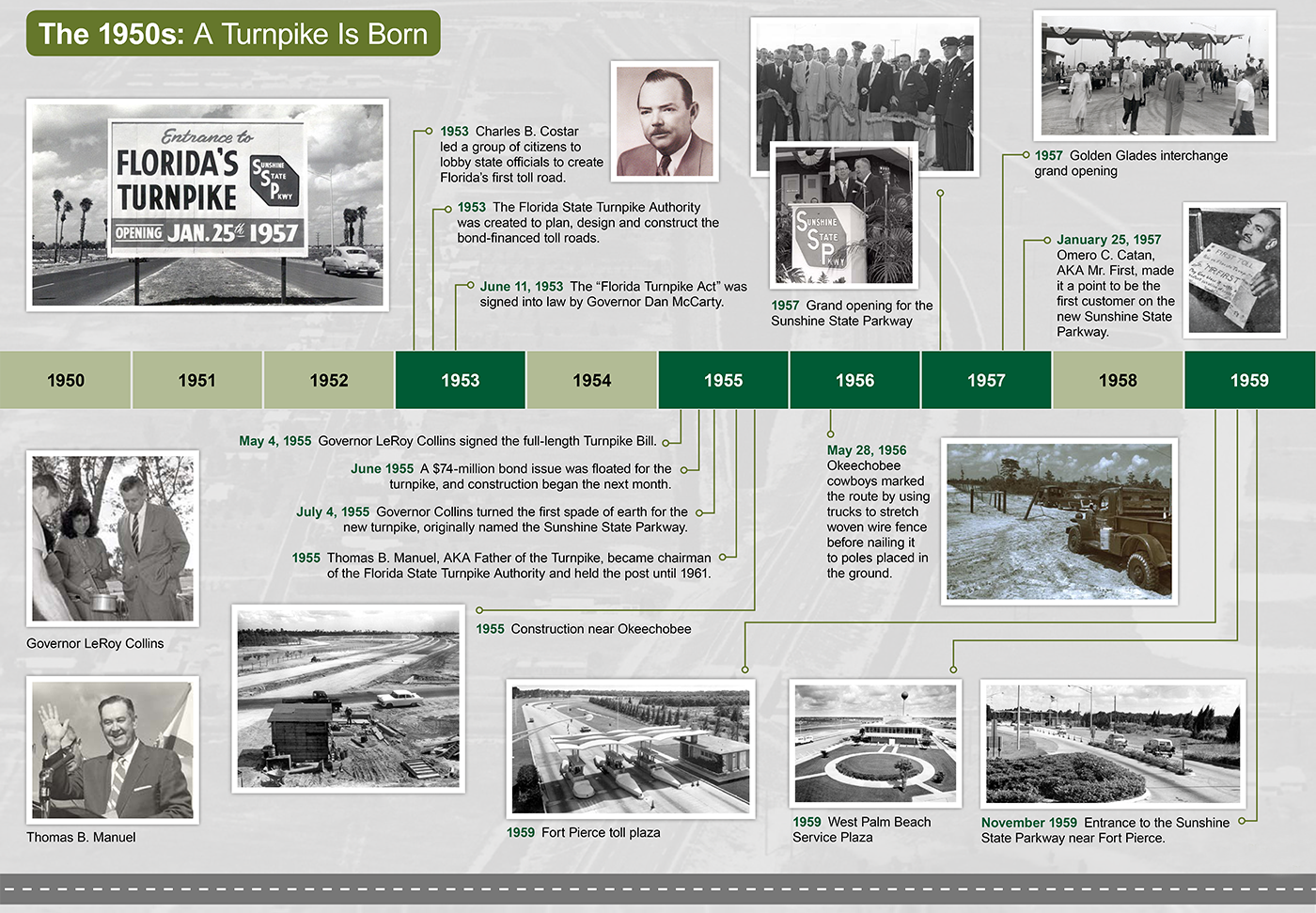
Timeline showcasing the development of Florida's Turnpike in the 1950s with key events and images from 1950-1959.

The 1950s: A Turnpike Is Born

Entrance to FLORIDA’S TURNPIKE

SUNSHINE STATE PKWY OPENING JAN. 25th 1957


1953

  • Charles B. Costar led a group of citizens to lobby state officials to create Florida’s first toll road.

  • The Florida State Turnpike Authority was created to plan, design, and construct the bond‑financed toll roads.

  • June 11, 1953: The Florida Turnpike Act was signed into law by Governor Dan McCarty.


1955

  • May 4, 1955: Governor LeRoy Collins signed the full‑length Turnpike Bill.

  • June 1955: A $74‑million bond issue was floated for the turnpike, and construction began the next month.

  • July 4, 1955: Governor Collins turned the first spade of earth for the new turnpike, originally named the Sunshine State Parkway.

  • Thomas B. Manuel — Father of the Turnpike — became chairman of the Florida State Turnpike Authority and held the post until 1961.

  • Construction near Okeechobee.


1956

  • May 28, 1956: Okeechobee cowboys marked the route by using trucks to stretch woven wire fence before nailing it to poles placed in the ground.


1957

  • Grand opening for the Sunshine State Parkway.

  • Golden Glades interchange grand opening.

  • January 25, 1957: Omero C. Catan — Mr. First — made it a point to be the first customer on the new Sunshine State Parkway.


1959

  • Fort Pierce toll plaza.

  • West Palm Beach Service Plaza.

  • November 1959: Entrance to the Sunshine State Parkway near Fort Pierce.

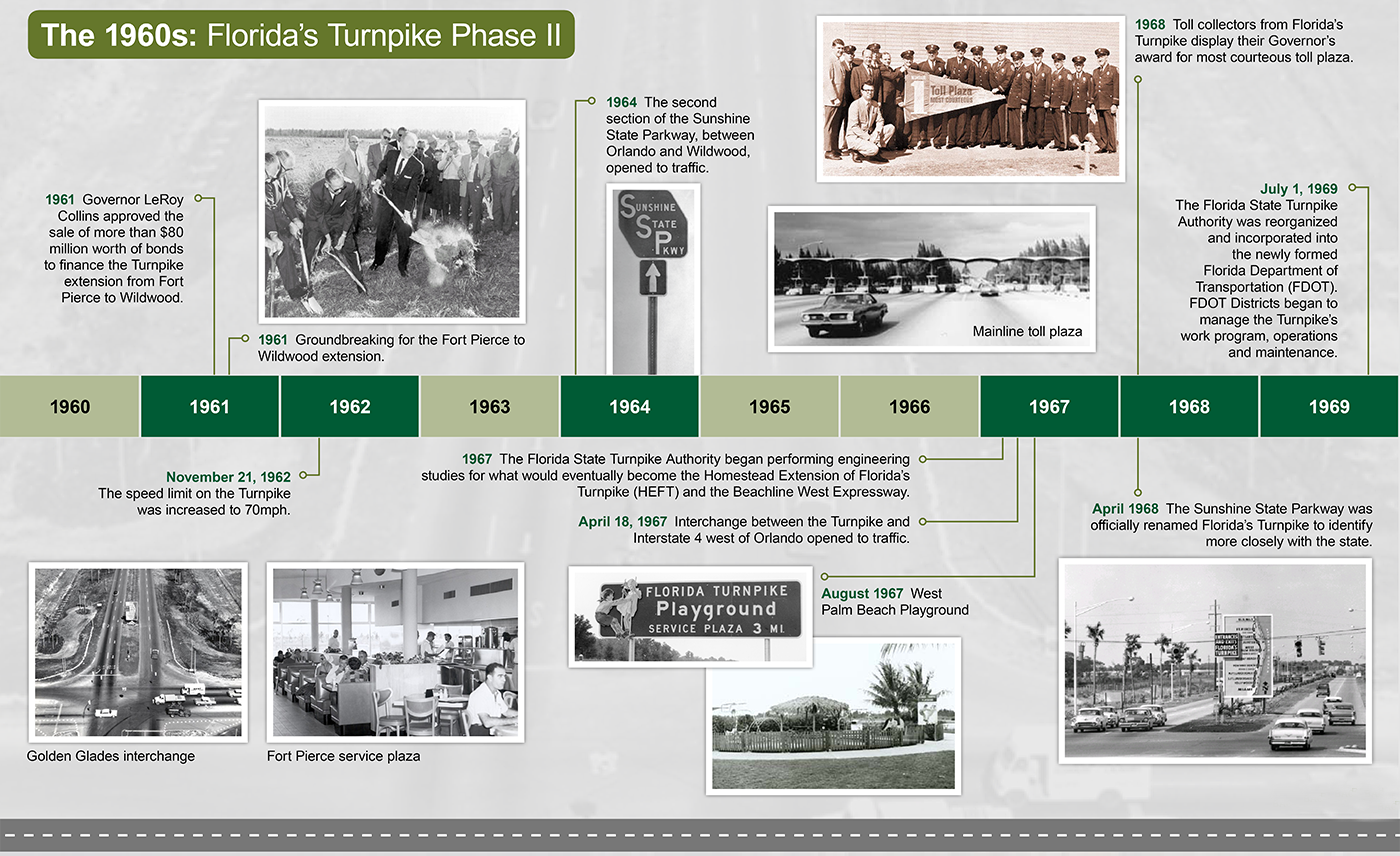
Timeline of Florida's Turnpike Phase II in the 1960s, showing key events, photos, and milestones from 1961 to 1969.

The 1960s: Florida’s Turnpike Phase II


1961

  • Governor LeRoy Collins approved the sale of more than $80 million in bonds to finance the Turnpike extension from Fort Pierce to Wildwood.

  • Groundbreaking for the Fort Pierce–Wildwood extension.


1962

  • November 21, 1962: The speed limit on the Turnpike was increased to 70 mph.


1964

  • The second section of the Sunshine State Parkway — between Orlando and Wildwood — opened to traffic.


1967

  • The Florida State Turnpike Authority began engineering studies for what would eventually become:

    • The Homestead Extension of Florida’s Turnpike (HEFT)

    • The Beachline West Expressway

  • April 18, 1967: Interchange between the Turnpike and Interstate 4 west of Orlando opened to traffic.

  • August 1967: West Palm Beach Playground.


1968

  • Toll collectors from Florida’s Turnpike display their Governor’s Award for most courteous toll plaza.

  • April 1968: The Sunshine State Parkway was officially renamed Florida’s Turnpike to more closely identify with the state.


1969

  • July 1, 1969: The Florida State Turnpike Authority was reorganized and incorporated into the newly formed Florida Department of Transportation (FDOT).

  • FDOT Districts began managing the Turnpike’s work program, operations, and maintenance.


As Seen in Pictures Above

  • Golden Glades interchange

  • Mainline toll plaza

  • Fort Pierce Service Plaza

  • West Palm Beach Playground

  • Toll collectors receiving Governor’s Award

  • Groundbreaking ceremony for the Fort Pierce–Wildwood extension

  • Florida Turnpike Playground sign

  • Traffic scene with roadway signage

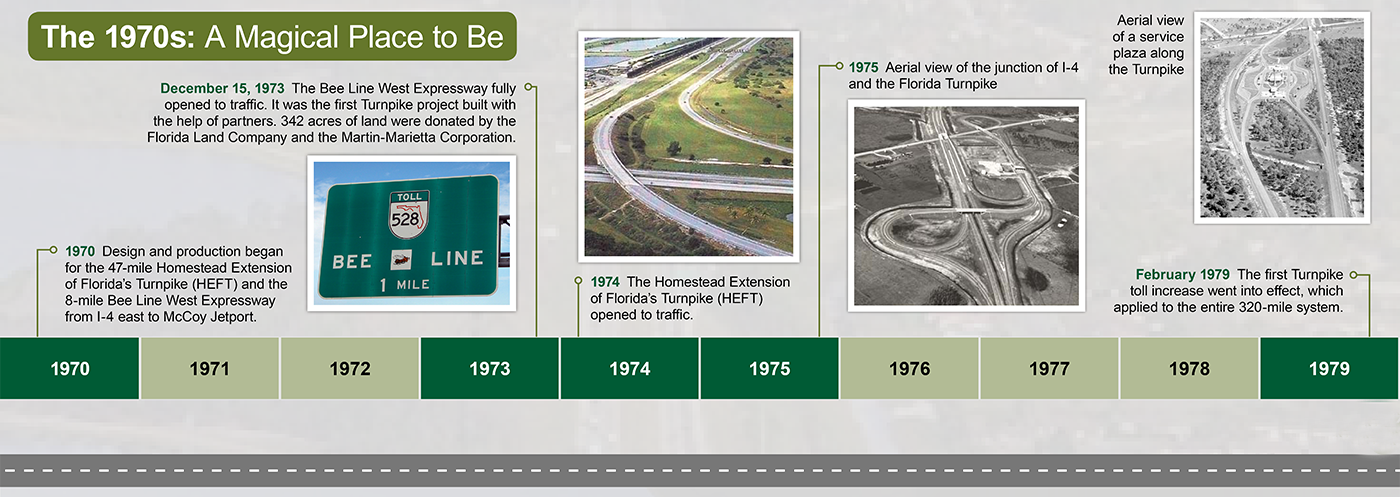
Timeline of 1970s Florida Turnpike projects with aerial views and toll sign. Highlights major expressway developments.

The 1970s: A Magical Place to Be


1970

  • Design and production began for:

    • The 47‑mile Homestead Extension of Florida’s Turnpike (HEFT)

    • The 8‑mile Bee Line West Expressway from I‑4 east to McCoy Jetport


December 15, 1973

  • The Bee Line West Expressway fully opened to traffic.

  • It was the first Turnpike project built with the help of partners.

  • 342 acres of land were donated by the Florida Land Company and the Martin‑Marietta Corporation.


1974

  • The Homestead Extension of Florida’s Turnpike (HEFT) opened to traffic.


1975

  • Aerial view of the junction of I‑4 and the Florida Turnpike.


1976

  • Aerial view of a service plaza along the Turnpike.


February 1979

  • The first Turnpike toll increase went into effect, applying to the entire 320‑mile system.


As Seen in Pictures Above

  • Road signage for the Bee Line West Expressway

  • Aerial view of I‑4 / Florida Turnpike junction

  • Aerial view of a Turnpike service plaza

  • Homestead Extension (HEFT) construction imagery

  • Bee Line West Expressway opening visuals

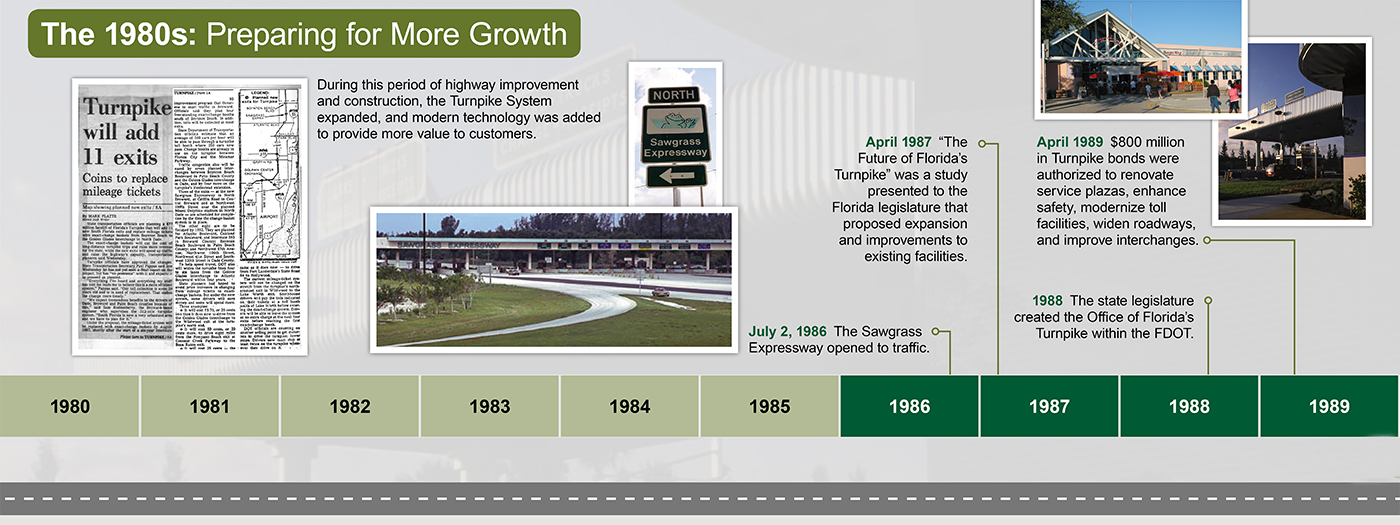
1980s Florida Turnpike timeline: expansions, tech upgrades, and 0M for improvements between 1986-1989.

The 1980s: Preparing for More Growth

During this period of highway improvement and construction, the Turnpike System expanded, and modern technology was added to provide more value to customers.


July 2, 1986

  • The Sawgrass Expressway opened to traffic.


April 1987

  • “The Future of Florida’s Turnpike” study was presented to the Florida Legislature, proposing expansion and improvements to existing facilities.


1988

  • The state legislature created the Office of Florida’s Turnpike within FDOT.


April 1989

  • $800 million in Turnpike bonds were authorized to:

    • Renovate service plazas

    • Enhance safety

    • Modernize toll facilities

    • Widen roadways

    • Improve interchanges


As Seen in Pictures Above

  • Newspaper headline: “Turnpike will add 11 exits — Coins to replace mileage tickets”

  • Sawgrass Expressway signage

  • Aerial or roadway views of Turnpike facilities

  • Turnpike system maps and construction imagery

  • FDOT and Turnpike branding from the era

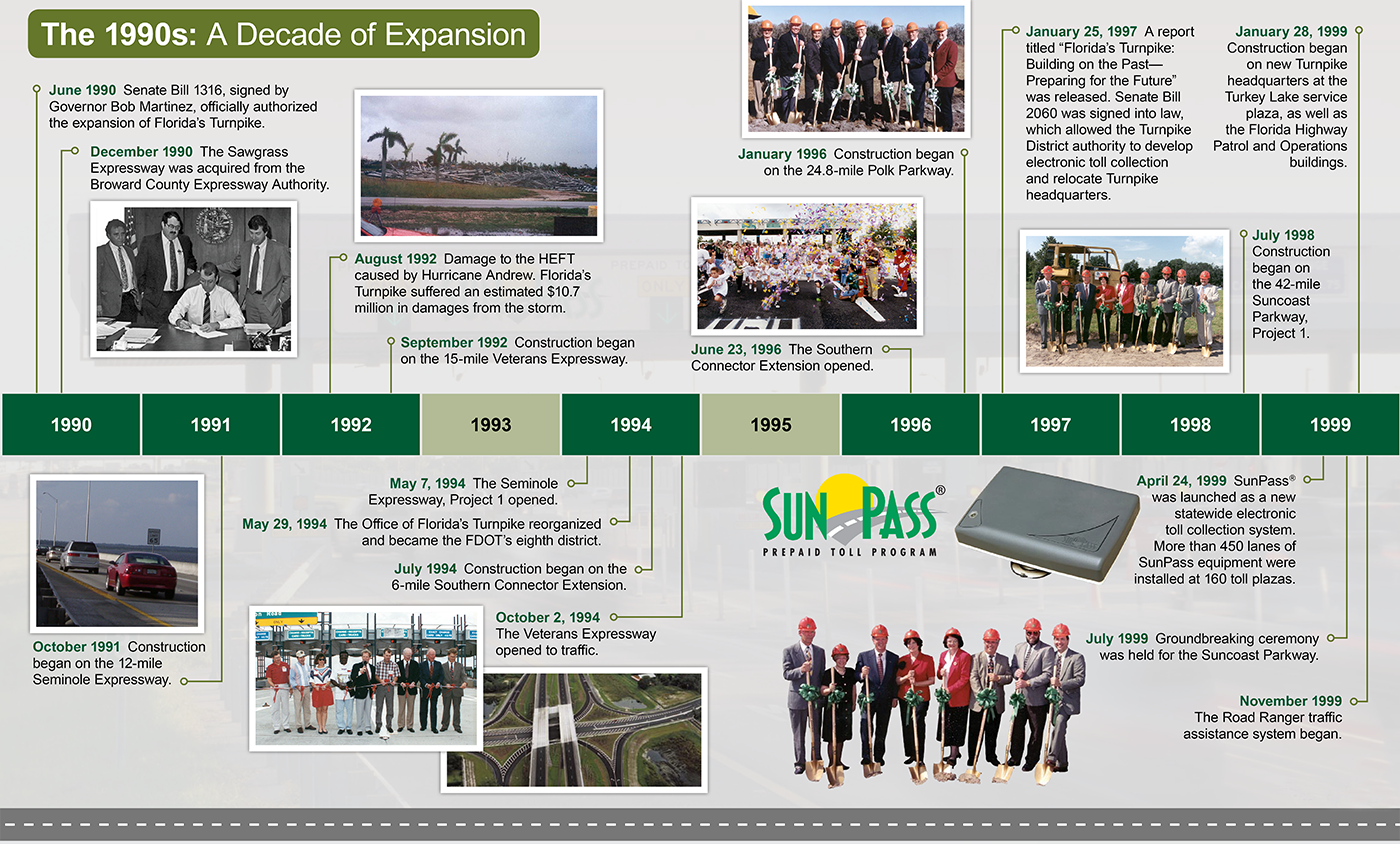
Timeline of 1990s Florida Turnpike expansion, including new expressways, construction milestones, and the launch of SunPass.

The 1990s: A Decade of Expansion


June 1990

  • Senate Bill 1316, signed by Governor Bob Martinez, officially authorized the expansion of Florida’s Turnpike.


December 1990

  • The Sawgrass Expressway was acquired from the Broward County Expressway Authority.


October 1991

  • Construction began on the 12‑mile Seminole Expressway.


August 1992

  • Damage to the HEFT caused by Hurricane Andrew.

  • Florida’s Turnpike suffered an estimated $10.7 million in damages.


September 1992

  • Construction began on the 15‑mile Veterans Expressway.


May 7, 1994

  • The Seminole Expressway, Project 1, opened.


May 29, 1994

  • The Office of Florida’s Turnpike reorganized and became FDOT’s eighth district.


July 1994

  • Construction began on the 6‑mile Southern Connector Extension.


October 2, 1994

  • The Veterans Expressway opened to traffic.


January 1996

  • Construction began on the 24.8‑mile Polk Parkway.


June 23, 1996

  • The Southern Connector Extension opened.


January 25, 1997

  • A report titled “Florida’s Turnpike: Building on the Past — Preparing for the Future” was released.

  • Senate Bill 2060 was signed into law, allowing the Turnpike District to develop electronic toll collection and relocate Turnpike headquarters.


July 1998

  • Construction began on the 42‑mile Suncoast Parkway, Project 1.


January 28, 1999

  • Construction began on new Turnpike headquarters at the Turkey Lake Service Plaza, along with new Florida Highway Patrol and Operations buildings.


April 24, 1999

  • SunPass® launched as a new statewide electronic toll collection system.

  • More than 450 lanes of SunPass equipment were installed at 160 toll plazas.


July 1999

  • Groundbreaking ceremony held for the Suncoast Parkway.


November 1999

  • The Road Ranger traffic assistance system began.


As Seen in Pictures Above

  • SunPass® Prepaid Toll Program branding

  • Damage to HEFT from Hurricane Andrew

  • Veterans Expressway construction and opening

  • Seminole Expressway construction and opening

  • Southern Connector Extension visuals

  • Polk Parkway construction

  • Suncoast Parkway groundbreaking

  • Turnpike headquarters construction at Turkey Lake

  • Newspaper clippings and roadway signage from the era

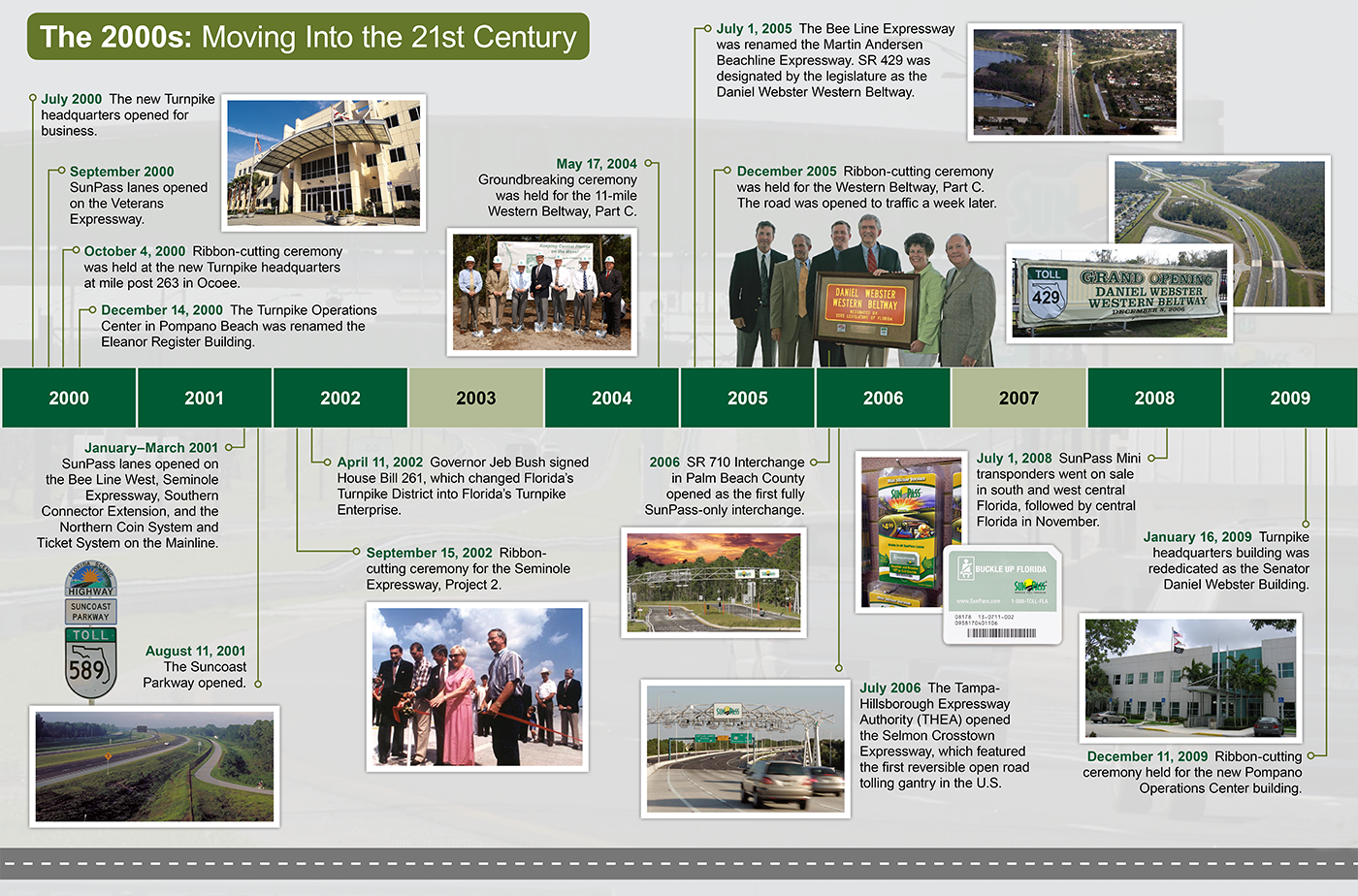
Timeline of Florida Turnpike milestones in the 2000s with images of ribbon cuttings and road developments.

The 2000s: Moving Into the 21st Century


July 2000

  • The new Turnpike headquarters opened for business.


September 2000

  • SunPass lanes opened on the Veterans Expressway.


October 4, 2000

  • Ribbon‑cutting ceremony held at the new Turnpike headquarters at milepost 263 in Ocoee.


December 14, 2000

  • The Turnpike Operations Center in Pompano Beach was renamed the Eleanor Register Building.


January–March 2001

  • SunPass lanes opened on:

    • Bee Line West

    • Seminole Expressway

    • Southern Connector Extension

    • Northern Coin System

    • Ticket System on the Mainline


August 11, 2001

  • The Suncoast Parkway opened.


April 11, 2002

  • Governor Jeb Bush signed House Bill 261, changing Florida’s Turnpike District into Florida’s Turnpike Enterprise.


September 15, 2002

  • Ribbon‑cutting ceremony for the Seminole Expressway, Project 2.


May 17, 2004

  • Groundbreaking ceremony for the 11‑mile Western Beltway, Part C.


July 1, 2005

  • The Bee Line Expressway was renamed the Martin Andersen Beachline Expressway.

  • SR 429 was designated as the Daniel Webster Western Beltway.


December 2005

  • Ribbon‑cutting ceremony for the Western Beltway, Part C.

  • The road opened to traffic one week later.


2006

  • SR 710 Interchange in Palm Beach County opened as the first fully SunPass‑only interchange.

  • July 2006: THEA opened the Selmon Crosstown Expressway, featuring the first reversible open‑road tolling gantry in the U.S.


July 1, 2008

  • SunPass Mini transponders went on sale in south and west‑central Florida.

  • Central Florida followed in November.


January 16, 2009

  • Turnpike headquarters building was rededicated as the Senator Daniel Webster Building.


December 11, 2009

  • Ribbon‑cutting ceremony held for the new Pompano Operations Center building.


As Seen in Pictures Above

  • New Turnpike headquarters at Ocoee

  • SunPass lanes and equipment

  • Suncoast Parkway opening

  • Seminole Expressway Project 2 ceremony

  • Western Beltway Part C construction and ribbon‑cutting

  • Selmon Crosstown reversible tolling gantry

  • SunPass Mini promotional materials

  • Pompano Operations Center building

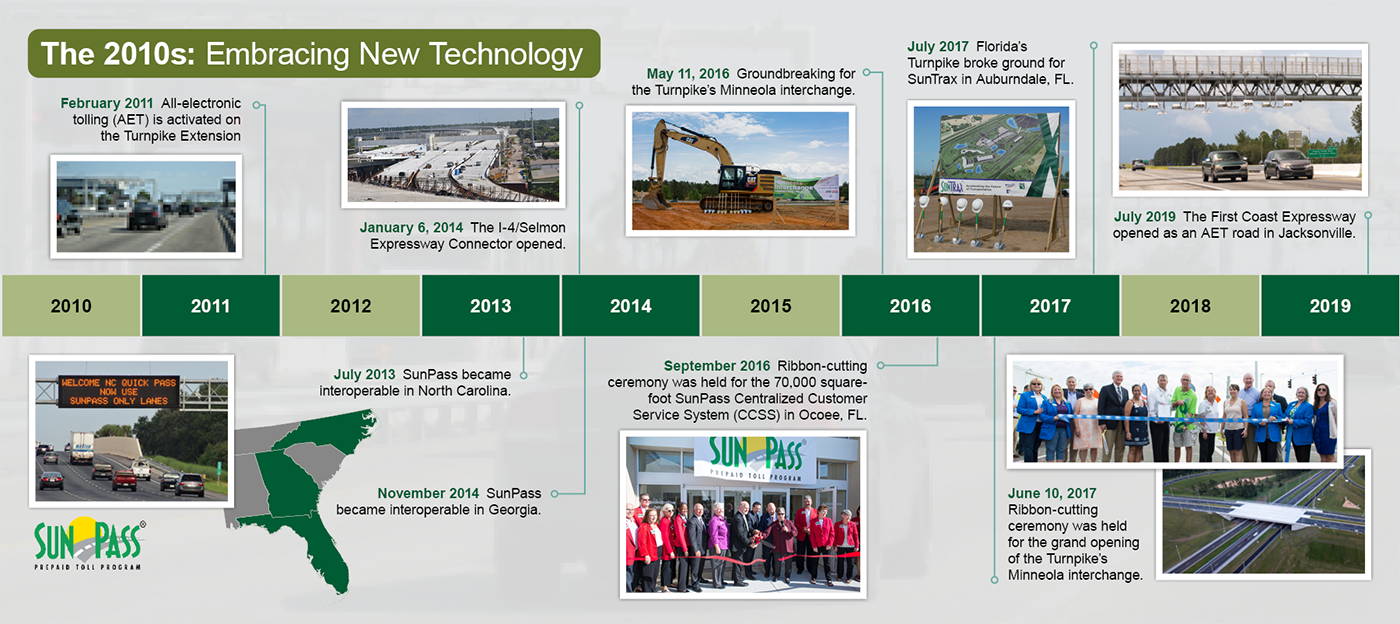
Timeline of SunPass and tolling advancements in Florida during the 2010s, including key events and milestones.

The 2010s: Embracing New Technology


February 2011

  • All‑electronic tolling (AET) activated on the Turnpike Extension.


July 2013

  • SunPass became interoperable in North Carolina.


January 6, 2014

  • The I‑4 / Selmon Expressway Connector opened.


November 2014

  • SunPass became interoperable in Georgia.


May 11, 2016

  • Groundbreaking for the Turnpike’s Minneola interchange.


September 2016

  • Ribbon‑cutting ceremony for the 70,000‑square‑foot SunPass Centralized Customer Service System (CCSS) in Ocoee, FL.


June 10, 2017

  • Grand opening ribbon‑cutting ceremony for the Turnpike’s Minneola interchange.


July 2017

  • Florida’s Turnpike broke ground for SunTrax in Auburndale, FL.


July 2019

  • The First Coast Expressway opened as an all‑electronic tolling (AET) road in Jacksonville.


As Seen in Pictures Above

  • SunPass interoperability signage (NC Quick Pass, Georgia)

  • I‑4 / Selmon Expressway Connector

  • Minneola interchange groundbreaking and ribbon‑cutting

  • SunTrax construction imagery

  • SunPass CCSS facility in Ocoee

  • AET activation visuals and roadway signage

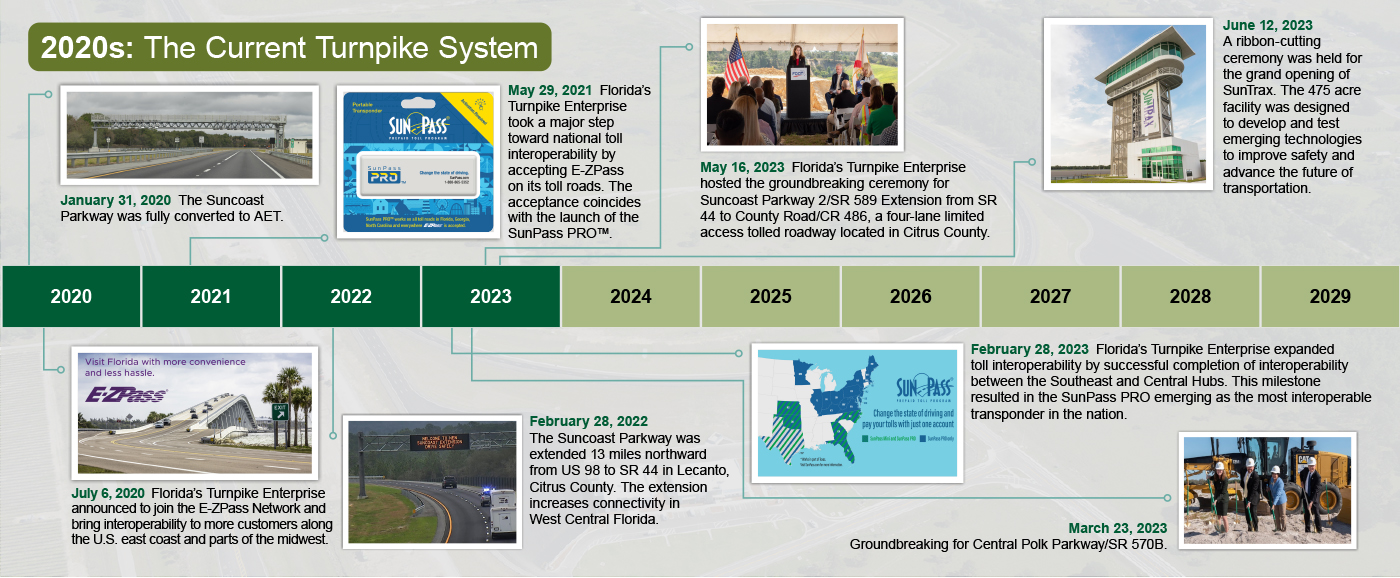
Timeline of Florida's Turnpike System upgrades and events from 2020 to 2023, featuring toll interoperability and expansions.

The 2020s: The Current Turnpike System


January 31, 2020

  • The Suncoast Parkway was fully converted to all‑electronic tolling (AET).


July 6, 2020

  • Florida’s Turnpike Enterprise announced it would join the E‑ZPass Network, expanding interoperability for customers along the U.S. East Coast and parts of the Midwest.


May 29, 2021

  • Florida’s Turnpike Enterprise took a major step toward national toll interoperability by accepting E‑ZPass on its toll roads.

  • This milestone coincided with the launch of the SunPass PRO™ transponder.


February 28, 2022

  • The Suncoast Parkway was extended 13 miles northward from US 98 to SR 44 in Lecanto, increasing connectivity in West Central Florida.


February 28, 2023

  • Florida’s Turnpike Enterprise expanded toll interoperability through successful completion of interoperability between the Southeast and Central Hubs.

  • SunPass PRO™ became the most interoperable transponder in the nation.


March 23, 2023

  • Groundbreaking for the Central Polk Parkway / SR 570B.


May 16, 2023

  • Groundbreaking ceremony for Suncoast Parkway 2 / SR 589 Extension from SR 44 to CR 486 in Citrus County.


June 12, 2023

  • Ribbon‑cutting ceremony for the grand opening of SunTrax, a 475‑acre facility designed to develop and test emerging transportation technologies.


As Seen in Pictures Above

  • Suncoast Parkway AET conversion

  • E‑ZPass and SunPass PRO™ interoperability signage

  • Suncoast Parkway extension construction

  • Central Polk Parkway groundbreaking

  • Suncoast Parkway 2 groundbreaking

  • SunTrax facility and ribbon‑cutting imagery